


Doing laundry by hand is still normal in plenty of Cuban homes, and anyone who has spent an afternoon scrubbing sheets in a bucket knows exactly why lavadoras en Cuba are such a sought-after purchase.
A washing machine saves hours every week, uses water more carefully than hand-washing usually does, and takes a physical chore off the list for people who are already stretched thin. This guide walks through what actually matters when picking one: size, water pressure, voltage, brands that hold up, and how to actually get the thing to Cuba in one piece.
Why Washing Machines Matter So Much in Cuba
Water service in much of Cuba is inconsistent. Many neighborhoods get water on a schedule rather than around the clock, so families store it in tanks and cisterns and use it carefully. A washing machine that’s built for that reality, one that doesn’t demand constant high pressure, matters more here than in most places.
Electricity is the other constraint. Voltage fluctuates, outages happen without warning, and appliances that can tolerate a rough power supply last longer than delicate ones. That’s a big part of why semi-automatic machines remain so popular on the island even though fully automatic models exist in every appliance catalog abroad.
There’s also the labor question. Hand-washing clothes for a family of four or five is genuinely hard physical work, and it eats up time that could go toward a job, childcare, or just rest. A working lavadora changes the rhythm of a household in a way that’s easy to underestimate until you’ve lived without one.
Semi-Automatic vs. Fully Automatic: Which One Fits Cuba Better
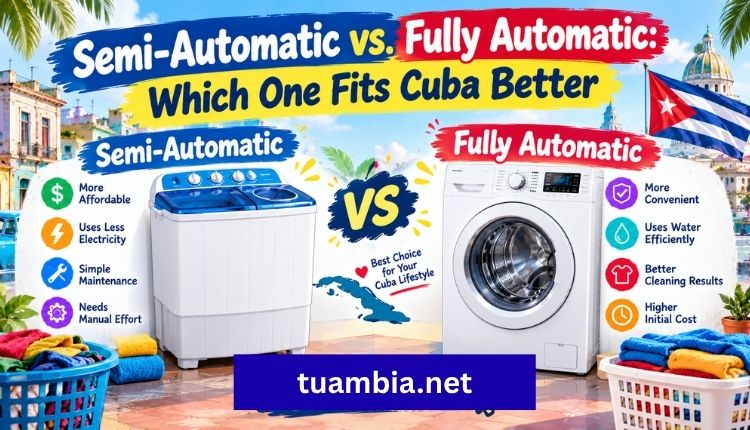
This is the first fork in the road for anyone shopping for lavadoras en Cuba, and the answer isn’t the same for every household.
Semi-automatic twin-tub machines wash and spin in separate tubs, and the user moves clothes between them by hand. They’re less convenient, but they’re also simpler mechanically, which means fewer parts to break and easier repairs when something does go wrong. They tolerate low water pressure and irregular voltage far better than automatic models, and they’re usually cheaper to buy and to fix. Brands like Royal, Haier, and various Chinese manufacturers dominate this category and are widely available through import services.
Fully automatic machines handle the entire cycle, wash, rinse, and spin, without anyone touching the clothes in between. They’re more comfortable to use and generally more efficient with water per load, but they need steadier voltage and more consistent water pressure to work properly. In neighborhoods with reliable infrastructure, particularly parts of Havana, these machines perform well. In areas with frequent outages or low pressure, they can develop problems faster than the semi-automatic alternative, visit more.
The honest answer: if the home has a cistern, a pump, and dependable electricity, an automatic machine is worth the extra cost. If any of those three is shaky, a twin-tub is the safer bet.
Choosing the Right Size and Capacity
Capacity for washing machines is measured in kilograms of dry laundry per load, and getting this number right avoids a lot of frustration later.
- 5-6 kg: fits a single person or a couple, and works well in small apartments where space is tight.
- 7-8 kg: the sweet spot for most Cuban families of three to five people.
- 9 kg and up: makes sense for larger households, or for anyone who also washes heavier items like blankets and towels regularly.
Buying too small means running the machine constantly and wearing it out faster. Buying too large wastes water and electricity on partial loads. It’s worth measuring the intended spot in the house too, since bathrooms and laundry patios in older Cuban homes are often narrower than modern appliance dimensions assume.
Brands Worth Considering
A few manufacturers show up again and again in Cuban households because parts are easier to find and repair technicians already know the models.
- Haier: widely imported, decent build quality, and semi-automatic models are common and affordable.
- Royal: a familiar name in the twin-tub category, valued for being simple to repair.
- LG and Samsung: found mostly in the fully automatic segment, chosen by households with stable power and water, and known for longer warranties when available through authorized dealers.
- Midea: increasingly common, competitively priced, and generally reliable for the semi-automatic line.
Whichever brand gets chosen, checking whether spare parts and local repair technicians exist for that specific model matters as much as the machine’s features. A well-reviewed washing machine with no available replacement belt or motor brush on the island becomes a very expensive doorstop.
Getting a Washing Machine to Cuba
Once the model is picked, the next question is logistics. Most lavadoras en Cuba arrive through courier and shipping services based in Miami or other parts of the diaspora, since large appliances aren’t something most people can simply order and have delivered directly on the island.
If you’re already organizing a shipment of food or household goods, it often makes sense to research reliable delivery pages for Cuba that can also handle appliance freight, since combining shipments tends to reduce cost. For readers who want a broader look at how delivery networks operate across the island, including timelines and what to expect at customs, that’s worth reading before committing to a specific courier.
A washing machine is also just one piece of a fully equipped kitchen or laundry area. Anyone furnishing a home from scratch may want to look at a complete guide to choosing electrodomésticos for Cuba, which covers appliance selection beyond just laundry equipment, or compare notes with families who went through Katapulk’s appliance catalog for washing machines, fans, and refrigerators bought together.
Water and Energy Efficiency
Because water isn’t always guaranteed to flow on demand, efficiency in Cuba means something slightly different than it does elsewhere. The relevant questions are:
- Can the machine run a full cycle using stored tank water, or does it need continuous line pressure?
- How many liters does a typical load use, and does that fit within what the household actually has stored on a given day?
- Does the model include a delay or timer function that lets someone run it after water service returns, without needing to babysit the machine?
Households that already run a refrigerador built for Cuba’s climate know this same logic: the appliance that wins isn’t necessarily the most advanced one, it’s the one built to keep working when the infrastructure around it doesn’t cooperate.
Maintenance Tips That Actually Extend Lifespan
- Clean the lint filter or drain trap after every few loads, since sediment in stored water tends to clog these faster than in places with treated municipal supply.
- Check hoses and connections for wear every couple of months, particularly on twin-tub models where hoses get moved and reattached by hand.
- Avoid overloading, since motors on many imported models aren’t built for the extra strain and this is the single most common cause of early failures.
- Keep the machine covered or under shelter if it sits outdoors or on an open patio, since sun and rain damage plastic housings and control panels faster than the mechanics inside.
- Use a voltage stabilizer where power fluctuations are frequent. This single accessory prevents a huge share of the motor and control-board failures technicians see on the island.
Cost and Budget Considerations
Semi-automatic machines are generally the more affordable entry point, and that price gap versus fully automatic models is often significant enough to change the decision entirely, especially once shipping costs get added on top of the machine’s retail price. Budgeting should include:
- The machine itself
- Shipping and customs handling
- A voltage stabilizer, if the home doesn’t already have one
- A basic parts kit or at least confirmation that a local technician stocks parts for that brand
Families who plan for these costs upfront tend to avoid the frustration of an appliance that arrives but can’t be installed or maintained properly.
Frequently Asked Questions
Is it better to buy a semi-automatic or fully automatic washing machine for Cuba?
It depends on water pressure and voltage reliability at the specific address. Semi-automatic machines handle inconsistent infrastructure better; fully automatic machines are more convenient where power and water are steady.
What size washing machine works best for a Cuban family of four?
A 7-8 kg capacity generally covers a household of that size without running the machine excessively or wasting water on undersized loads.
Which brands are easiest to repair in Cuba?
Haier, Royal, and Midea are widely used and technicians are generally familiar with their parts and mechanisms, particularly in the semi-automatic range.
How do people usually get a washing machine to Cuba?
Most arrive through courier and shipping services based in Miami or elsewhere in the diaspora, often bundled with other household goods to reduce shipping costs.
Does a voltage stabilizer really make a difference?
Yes. Voltage spikes and drops are one of the leading causes of motor and control-board failure in imported appliances, and a stabilizer is a relatively small expense compared to a replacement machine.
Choosing the right lavadora for Cuba comes down to matching the machine to the house it’s going into, not just picking whatever looks the most modern in a catalog. A twin-tub that survives a shaky power grid and irregular water service will outlast a fancier machine that can’t handle either.
