

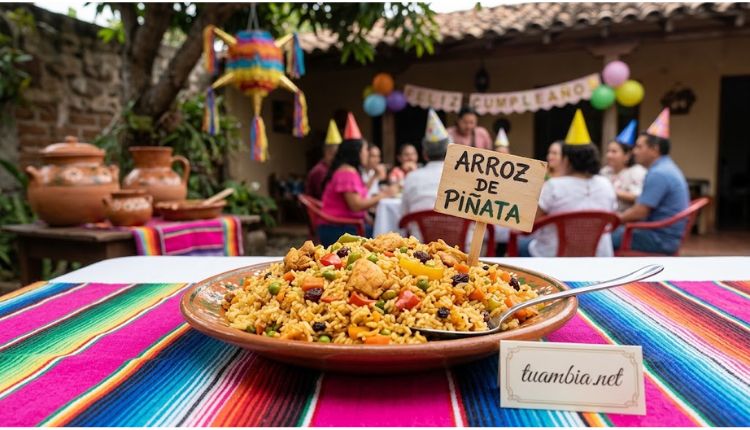
Walk into any birthday party in Nicaragua, and you’ll smell it before you see it: a pan of yellow rice, studded with chicken, olives, and bits of sweet pepper, sitting next to the cake like it’s just as important. That’s arroz de piñata, and honestly, at a lot of parties it is just as important as the cake.
The name translates loosely to “piñata rice,” and it earns that name the honest way. It’s the dish Nicaraguan families cook whenever there’s a piñata to break, which in practice means birthdays, baptisms, and pretty much any celebration with kids running around a backyard.
What Exactly Is Arroz de Piñata?
Arroz de piñata is a colorful, savory rice dish loaded with chicken and sometimes pork, mixed vegetables, olives, raisins, and a tomato-based sofrito that gives it that deep golden-orange color. It’s closer to a Spanish-style rice casserole than to plain steamed rice, and it’s built to feed a crowd. You rarely see it made in small batches. If someone’s making arroz de piñata, they’re making a whole pot for the whole party.
In many Nicaraguan homes, this same dish also goes by another name: arroz a la valenciana. Ask ten different families which term they use, and you’ll probably get a mix of both, sometimes from the same person depending on whether they’re talking about the dish itself or the occasion it shows up at.
Where the Dish Actually Comes From

The valenciana in the name is a real clue. The dish traces back to Spain’s Valencia region, an area famous for its rice fields and, of course, paella. When Spanish culinary traditions made their way to Central America, the rice dishes adapted to what was locally available: local chicken instead of rabbit or seafood, and a sofrito built around what Nicaraguan kitchens already had on hand.
Over generations, the Valencian rice dish shed its Mediterranean seafood leanings and became something distinctly Nicaraguan. It picked up raisins for sweetness, more vegetables for color, and a habit of showing up specifically at parties, which is how it eventually picked up its nickname.
Why “Piñata” and Not Just “Party Rice”
In Nicaragua, breaking the piñata is often the centerpiece moment of a kids’ birthday party, the same way blowing out candles is elsewhere. Because the piñata moment is so central to the celebration, the food served alongside it started borrowing the name.
Arroz de piñata isn’t a separate recipe from arroz a la valenciana so much as a nickname earned through repetition. Cook a big pot of yellow rice for enough birthday parties in a row, and eventually people just start calling it “the piñata rice.”
What Goes Into a Traditional Arroz de Piñata
Recipes vary from household to household (this is a dish built on family habits, not strict rules), but most versions include:
- Chicken, usually bone-in pieces, sometimes with pork added for extra flavor
- Long-grain rice, cooked in a rich broth rather than plain water
- Sofrito made from tomatoes, onions, garlic, and bell peppers
- Green olives, which add a briny contrast to the sweetness elsewhere in the dish
- Raisins, a somewhat unexpected but essential touch of sweetness
- Mixed vegetables like carrots and peas for color and texture
- Achiote or annatto, which gives the rice its signature golden-red hue
Some cooks toss in diced ham, chorizo, or even hot dogs for kids’ parties. Others keep it closer to the original Spanish-style version. There’s no single “correct” recipe, which is part of why the dish still feels alive instead of frozen in a cookbook.
How Arroz de Piñata Is Typically Made
The general process looks something like this:
- Brown the chicken (and pork, if using) in a large pot, then set it aside.
- Build the sofrito in the same pot, cooking down tomatoes, onions, garlic, and peppers until fragrant.
- Add the rice and toast it briefly in the sofrito so it soaks up the flavor before any liquid goes in.
- Pour in broth, return the chicken to the pot, and add achiote for color.
- Simmer until the rice is tender and most of the liquid has absorbed.
- Fold in olives, raisins, and vegetables near the end so they keep their texture instead of turning mushy.
- Rest, then serve straight from the pot, family-style, alongside the rest of the party spread.
Because it’s cooked as one big batch, arroz de piñata is genuinely easier to prepare for a crowd than most rice dishes. That practicality is a big part of why it became the go-to party food in the first place.
Arroz de Piñata vs. Arroz a la Valenciana: Are They the Same Dish?
Mostly, yes. The ingredients and cooking method overlap almost completely. The difference is really about context rather than recipe. If you ask for arroz a la Valenciana, you’re referencing the dish’s Spanish roots. If you ask for arroz de piñata, you’re referencing when and why Nicaraguans eat it. Some families genuinely treat them as interchangeable names for the same pot of rice; others insist there are small tweaks (a bit more sofrito, a slightly different vegetable mix) depending on which name they grew up using, Visit more.
Serving Arroz de Piñata at Your Own Party
If you’re planning a celebration and want to bring a taste of Nicaragua to the table, arroz de piñata pairs naturally with the kind of festive setup that already centers on shared, colorful food and a bit of spectacle, not unlike the way a well-chosen piñata brings its own bright energy to a party. Serve the rice family-style in a large dish, keep it warm, and let people go back for seconds, because they will.
It also fits comfortably alongside other Latin American celebration staples. If you’re curious how food traditions differ across the region, Cuban party food carries its own distinct character, shaped by different ingredients and history but built around that same idea: food as the heart of the gathering, not just a side detail.
Sourcing Ingredients When You’re Not in Nicaragua
Getting the right ingredients together- achiote, good olives, quality chicken- can be trickier outside Central America. If you’re cooking for family abroad or trying to recreate a taste of home, it helps to have a reliable way to get groceries where they need to go. Services built around sending food and groceries to Cuba follow the same logic that makes dishes like arroz de piñata possible in the first place: making sure the right ingredients reach the right kitchen, wherever that kitchen is.
For anyone coordinating a bigger celebration and stocking a kitchen from a distance, a dependable grocery delivery service to Cuba can take care of the logistics while you focus on the cooking.
And if part of your celebration plan includes eating out or comparing how different cities do Latin comfort food, spots like Havana Vieja in Miami show how these food traditions travel and adapt once they cross borders.
Frequently Asked Questions
Is arroz de piñata spicy?
No. It’s savory and slightly sweet from the raisins, not spicy. Any heat is usually added separately, if at all.
Can I make arroz de piñata without pork?
Yes. Many versions use only chicken. Pork is common but not required.
What’s the difference between arroz de piñata and regular Spanish rice?
The core method is similar, but arroz de piñata leans sweeter (thanks to the raisins) and is almost always cooked in large batches meant for parties rather than everyday meals.
Why do Nicaraguans call it “piñata rice” instead of just “party rice”?
Because the piñata is such a central part of Nicaraguan birthday celebrations that the food served alongside it picked up the name over time.
The Bottom Line
Arroz de piñata is what happens when a Spanish rice tradition settles into a new country and takes on that country’s rhythms, its parties, its ingredients, its sense of occasion. It’s not a fussy dish. It’s a generous one, built to feed everyone at the table and built around the idea that a good celebration deserves food that matches the energy in the room.
