

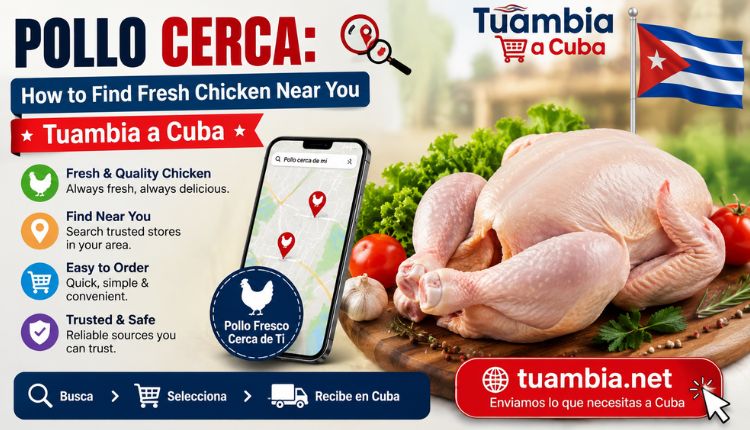
Type “pollo cerca” into Google at 5 p.m. on a weeknight and you already know what’s going on. Dinner is looming, the fridge is bare, and you need chicken now, not after a twenty-minute drive across town. It’s one of the most common grocery searches out there, right up with “pan cerca” and “farmacia cerca de mí,” and for good reason: chicken is the default protein in most kitchens, Cuban ones included.
This guide covers both sides of that search. The first half is for anyone standing in their kitchen wondering where to buy good chicken nearby, today, without wasting a trip. The second half is for something a little different: what “pollo cerca” means when the person you’re feeding isn’t near you at all, because they’re in Cuba and you’re trying to get chicken to their table from a thousand miles away.
What People Actually Mean When They Search “Pollo Cerca”
Not every “pollo cerca” search is the same search. Some people want a rotisserie chicken they can pick up in fifteen minutes. Some want raw chicken breast for meal prep and are comparing three stores by price per pound. Others, especially in Cuban and Latin American households abroad, are searching because they’re trying to find a way to send chicken and other alimentos to relatives back home, and “near me” really means “near enough to arrange delivery.”
That last group is worth pausing on, because it’s a real gap in how most grocery apps work. A supermarket locator can tell you the closest store. It can’t tell you how to get a package of chicken thighs into a kitchen in Holguín or Camagüey. That takes a different kind of “near,” one built on shipping routes and delivery networks rather than GPS pins. If you’ve ever hunted for a party and come up with three options in five minutes, you already know how much easier this is when the thing you’re looking for is actually local. Chicken for a Cuban household is often the opposite case. Visit more,
Finding Pollo Cerca the Old-Fashioned Way: Local Stores and Butchers
If you’re shopping for yourself, the basics still work. Chain supermarkets are reliable for consistency and price, but a neighborhood butcher or carnicería usually wins on freshness and cut selection. Ask when their poultry delivery comes in; most butchers get fresh shipments two or three times a week, and buying on delivery day makes a noticeable difference in texture and shelf life.
A few things worth checking before you commit to a spot:
- Color and smell: Fresh chicken should be pale pink, not gray or yellow-tinged, and shouldn’t smell like much of anything.
- Packaging date, not just sell-by date: Some stores rotate stock slowly even when the sell-by date looks fine.
- Price per pound versus price per package: Family packs look cheaper until you calculate the actual per-pound cost against a smaller cut.
- Whether they sell whole birds or only parts: Whole chicken is almost always cheaper per pound if you’re willing to break it down yourself.
None of this is complicated, but it’s the kind of thing people skip when they’re in a hurry, which is usually exactly when the “pollo cerca” search happens in the first place.
When Nearby Isn’t Actually Nearby: Sending Pollo to Cuba
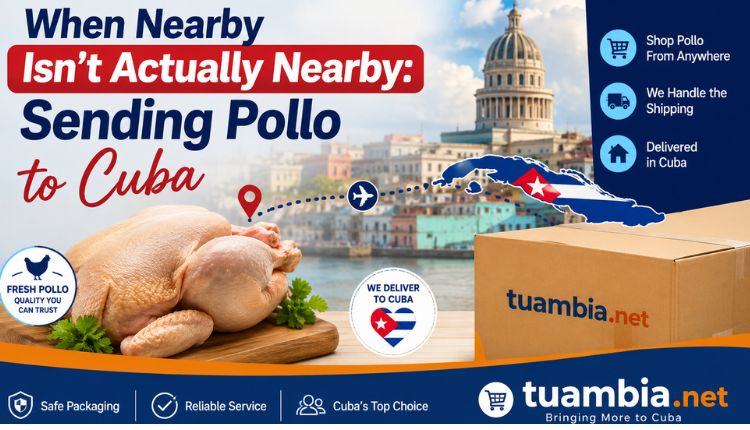
Here’s where the search takes a turn for a lot of our readers. Food access in Cuba is inconsistent enough that “nearby” chicken for a family member there might not exist on any given week, no matter how close the market is. State-run shops run out. Prices swing. A place like this might have chicken on Tuesday and nothing but rice on Thursday. This is the actual reason services like Tuambia exist: to make “near” mean something different, shipping alimentos from outside the country so a relative’s kitchen has chicken even when the closest store to them doesn’t. Visit more.
If you’ve read about Villa Blanca Supermarket, you’ve seen how these stores work: you buy online from wherever you are, and the order gets delivered to a specific address in Cuba, chicken included, without your relative having to stand in a line that might end with an empty shelf. It flips the whole “pollo cerca” question around. Instead of asking where the nearest chicken is, you’re deciding what “near” should mean for someone else, and then paying to make it true.
Comparing Local Purchase and Cuba Delivery
The two situations aren’t really competing with each other, but people sometimes ask which is “better,” so here’s the honest comparison:
Buying chicken locally is faster, cheaper per pound, and gives you full control over the cut and quality. It only works if you’re the one eating it, or if the person you’re feeding lives close enough to hand it to directly.
Sending chicken through a Cuba delivery service costs more per pound once you factor in shipping, and you’re trusting a third party’s inventory rather than picking the piece yourself. What you’re actually paying for is reliability: the chicken shows up whether or not the local market had any that week.
For a lot of families, that reliability is worth more than the price difference. Related services like envío de comida a Cuba desde Miami exist precisely because “we’ll figure it out when we get there” isn’t a plan people want to rely on for something as basic as protein.
Keeping It Fresh Once It Arrives
Fresh chicken is only as good as the fridge it lands in. This matters more in Cuba than almost anywhere else, since power cuts are common and a lot of household refrigerators are decades old and running on borrowed time.
If chicken is being delivered regularly, it’s worth making sure the receiving household actually has working cold storage, not just a working stove. Some families end up ordering a alongside their food shipments for exactly this reason. A delivery of chicken means nothing if it spoils within a day because the fridge can’t hold a temperature.
Practical Tips for Either Situation
Whether you’re standing in a supermarket aisle or setting up a recurring shipment, a few habits make the whole “pollo cerca” search less of a headache going forward:
- Keep a running note of which local store or which delivery service actually had chicken in stock last time, rather than relying on memory.
- If you’re shipping to Cuba, order a bit ahead of when the household will run out, since delivery windows aren’t instant.
- Ask about combined orders. Services that bundle chicken with other alimentos, the way shipments often do, tend to be more cost-efficient than ordering meat alone.
- If you’re building a recurring routine, look at broader delivery plans like instead of one-off orders. Consistency matters more than any single shipment.
Wrapping Up
“Pollo cerca” starts as a simple search, but it points to two very different problems depending on who’s asking. For most people, it’s about getting dinner on the table without an extra trip across town, and the fix is knowing your local butchers and shopping on delivery days.
For families with someone in Cuba, it’s a bigger question about food security, and the answer usually isn’t a nearby store at all. It’s a delivery network that can make chicken show up reliably, week after week, in a kitchen that might otherwise go without.
